A round bale left on the ground loses a quarter of itself by spring. At $200 hay, that is $50 a bale.
Outside storage on bare ground costs 20 to 40 percent of the dry matter in a round bale, and the part that rots is the part the cow was going to eat first. Rows, gravel, tarps, and barns, ranked by what they save and what they cost. Plus how to feed the bad ones so the cows do not do the sorting.
Oct 7
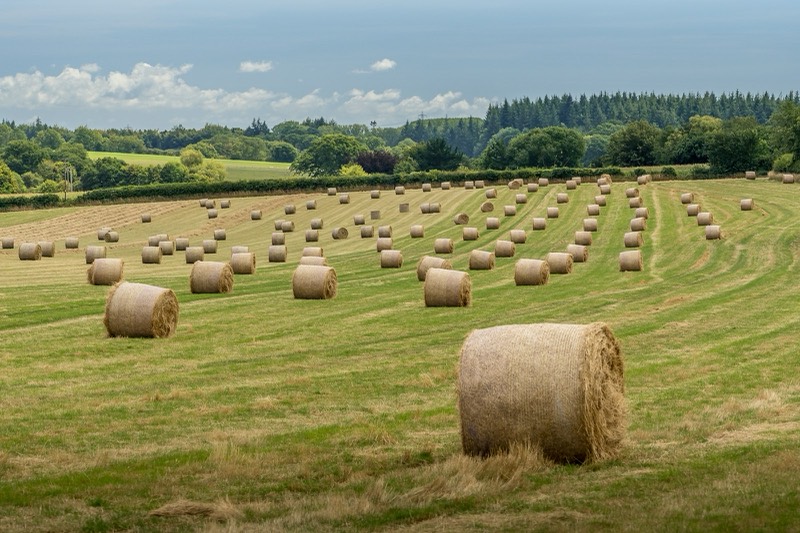
The hay is made. It is sitting in the field, or in a row along the fence, or stacked three high in a pile behind the barn where it has always gone. Between now and February, a good share of it is going to disappear, not into a cow, but into a mat of black mold on the bottom and a weathered shell on the outside. How much depends almost entirely on where you put it.
The losses, measured
University trials across the fescue belt and the Plains have measured dry matter loss in round bales stored from summer to winter feeding. The ranges hold up:
- On the ground, uncovered, in the open: 20 to 40 percent lost. Higher in wet climates and with loose bales.
- On the ground, uncovered, in a tight row with ends butted: 15 to 25 percent.
- On a gravel pad or pallets, uncovered: 10 to 15 percent. Getting the bale off the wet ground stops the wicking that causes most of the damage.
- Off the ground and tarped: 5 to 10 percent.
- In a barn or under a roof: 2 to 6 percent.
The loss is worse than the number, because what rots is the outer 4 to 6 inches, and in a 5-foot bale that outer layer is about a third of the volume. It is also the layer that was on top in the windrow, which is the leafiest hay in the bale. What is left after the cow refuses the mold is stemmier and lower in protein than the test said.
The math at today's prices
A 1,200-pound bale at $200 a ton is a $120 bale. Thirty percent loss is $36. On a place that feeds 400 bales a winter, that is over $14,000 rotting on the ground. A 40-by-100 pole barn that holds those bales costs $40,000 to $60,000 and lasts thirty years. Gravel and tarps for the same hay run a few thousand up front and a few hundred a year in tarps.
Put another way, a barn pays for itself in four to six winters at current hay prices, faster if you are buying hay rather than making it. That number was not true when hay was $80.
If it has to stay outside
Do these, in order of what they save:
- Get it off the dirt. A 6-inch bed of crushed rock, old tires, pallets, or even a row of poles. Wet soil wicking up into the bottom is the single biggest loss.
- Make dense bales. A tight bale sheds water; a loose one soaks it up. Slow the baler down and make sure the density setting is up.
- Rows, not piles. Run rows north-south so both sides get sun. Butt the flat ends tight together so the row is one long cylinder. Leave 3 feet between rows so air moves and water runs off; a pyramid stack traps water in every valley and rots from the inside.
- Well-drained ground, in the open. Not under trees, not in the low spot behind the barn. A little wind is your friend.
- Net wrap over twine. Net wrap sheds rain better and holds the bale tighter. Losses are typically a third lower than with twine.
- Tarp the good stuff. If you can only cover some of it, cover the alfalfa and the best grass hay you are saving for lactating cows and heifers. Let the cornstalks and the late-cut stuff weather.
Feed the weathered bales right
The cows will sort out the weathered layer, pull it apart looking for the good hay in the middle, and lie on the rest. That turns a 20 percent storage loss into a 40 percent total loss. Two fixes: feed the outside bales first, before they get worse, and put them in a ring feeder with a sheeted bottom or a cone, which cuts feeding waste from 30 percent or more to under 10. Unrolling weathered hay on the ground in a dry pasture works if you unroll only what they will clean up in a day.
Test what you have left
The hay test you ran in August described the bale as it was in August. By January, an outside-stored bale has lost a chunk of its digestible energy along with the leaf. If you are balancing a late-gestation ration on last summer's test, and the hay was stored outside, pull a new core and re-test. The forage-test explainer from last month walks through the numbers. The cheapest ton of hay you feed this winter is the one you did not let rot.
Reporting from University of Kentucky Extension.
Comments
Sign in or create an account to join the conversation.